PSSSSST!
We're under
construction,
but please
feel
free to browse!
When you
hit
a dead end
simply
click
the
GO
Back
button
on the
browser.
Thank
you
for
your patience! |
| NOTABLE QUOTES
It seems that
for success in science and
art, a dash
of
autism is essential.
Hans Asperger
You have got
to keep the autistic child
engaged with
the world.
You cannot
let him/her
tune out.
TempleGrandin
HYPERLINKS:
|
Autism and Tantrums
are
related to each other.
Aside
from the fact
that autism is
a
contributor
to
the behavior,
there is
truly nothing
wrong
with autistic
children acting
out tantrums.
Children may act irrationally
with heightened
fear, anxiety, panic,
and rage. These
are typical in an
autistic child.
These actions
also involve
distracting manners,
like pushing other
children away,
defying contact
with others,
uncontrollable
crying, and
screaming.
Parents find it
hard to prevent
these disturbing actuations from happening. In
fact, biting,
pinching, and
hitting are
inconsolable, &
may last for a
long period.
Panic, rage aggression, will
continue from childhood,
thru adolescence
and even
until adulthood.
WHAT TO DO?
A most effectual
and ideal way to
handle tantrum
behaviors is to
ignore the act.
Parents must
teach their
children how to
express and
manage anger.
Parents or
guardians need
to recognize the
causes of the
child's emotional instability.
Never blame,
reprimand, or
even
shout at
the child. In autism, there is always a
reason behind
every child's
obstinate attitude.
Be patient, explore,
be understanding
about your
child's behavior.
The
key is to give,
not to give in. Autism demands
constant open communication,
not tolerance. |
|
Ron's
FORTHCOMING EVENT
|
 |
|
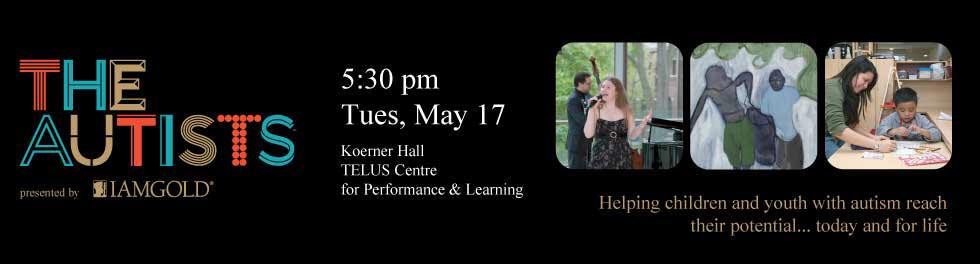
The 2011 edition
of THE AUTISTS Gala and Art Auction will take place on
May 17, 2011 at the magnificent and critically acclaimed
Koerner Hall. The glittering annual gourmet Gala
attracts some 350-400 art supporters; international
buyers and collectors; top philanthropists and prominent
business people. At last year’s Gala a small Peter Doig
work sold for $160,000 to a Manhattan buyer who engaged
in a battle royal with another NYC bidder.
Venue: Koerner Hall, Telus Centre (Royal Conservatory of
Music)
Date: Tuesday, May 17, 2011 Time: 5:30 pm $195 per
person .
The proceeds of
THE AUTISTS go to provide much needed support and 'social
skills' training to children and
youth faced with the daily challenges of Autism Spectrum
Disorder (ASD). Today, more children are diagnosed with ASD than
AIDS, diabetes and cancer combined; and ASD is the fastest.
Entertainment Lineup:
JOHN ALCORN
- MUSICAL
DIRECTOR - John has been tearing up the Toronto music scene
since the mid-1990s with his stylish renditions of jazz
standards performed at hundreds of clubs and events around the
city.
SHAWN
BYFIELD
-
Shawn Byfield has the distinction of receiving a Dora Award for
choreography
in the award winning musical "i think i can". Shawn also has had
the honour of being nominated
for a Gemini Award.
VITO REZZA
- Vito
Rezza has built a reputation as a superstar drummer in Toronto's
vibrant music scene for three decades. He is also the leader of
the critically acclaimed, Juno-nominated jazz ensemble “5 After
4”.
SAMANTHA MUTIS
- Nineteen year old Samantha Mutis is a
gifted singer who was diagnosed with
Asperger Syndrome at age four. She currently attends the
University of Toronto in the Bachelor
of Performance/Jazz Vocal Program on an academic scholarship.
RON ADEA
- Ron Adea is a young talented
musician with a diagnosis of Autism Spectrum Disorder. Ron
developed an interest in music and the piano at a very early
age. Today at only 18, Ron has been able to capture the soul of
works of the great classical composers such as Chopin, Beethoven
and Debussy; he is a budding concert pianist; a wonder and
inspiration.
MICHAEL MOON
- Michael Moon is a Toronto musician, composer and performer,
with a diagnosis
of Autism Spectrum Disorder. He believes in the power of music
to heal and transform. From meditative,
relaxing new age to inspiring pop and shamanic rock, his music
crosses the boundaries between mystical and ethnographic.
FOR COMPLETE
INFORMATION on THE AUTISTS, PLEASE CLICK THIS URL:
http://www.autism.net/foundation/events/the-autists/entertainment.html |
|
Ron launched his web site in 2006 |
|
From Toronto, Ontario, Canada,
June, 2006: Hello! My name is
Ron Michael
Quesada Carolino Adea. I am autistic. I am
14 years old.
I still have a hard time speaking
what I exactly want to say. I studied piano very young. I now perform at
concerts & recitals. Sometimes I forget I have bad manners. I go into tantrums
when I get upset. My Mama & Papa teach me
Control & Relax. I want to learn
everything. My brain is very busy. My favorite Web site is the
Hilary Duff's official homepage
because she is my favorite singer. In the Philippines my favorite is
Sarah Geronimo.
Their songs make me happy. I listen to some of them and try to play on my piano
by ear. I enjoy playing mostly classical music.
[CLICK IMAGES FOR LARGER VIEW; ]CLick browser's
GO BACK button to return here] |
|
 |
 |
 |
|
Piano teacher,
Ms.
Eileen Keown |
Merriam School of Music |
1st piano teacher
Mrs.
Jane Trung Tu |
I start high school
this year. I still can't speak very well
but I'm good at writing and reading. I love to be with people
but I confuse them
because I am learning how to act properly. I hang out with my friends
Timothy
&
Taylor.
I am very close with my cousins
Ryan & Christian Carolino,
Daniel Asuncion, Jill and Gil Garrovillo & Ligene Pilar
and I sleepover at their house. I miss my cousins
Cheenee & Jerome Carolino
& Audrey Adea
in Manila. My youngest uncle
Arnold Quesada
is my big buddy. He lives in Scarborough. I feel safe when I am with them because they teach me and assist me how to talk and be social with people.
I like to dance hip-hop. My cousin Audrey taught me the
otso otso and chiwawa. I like line dancing, too. My
Dad
and
Mom
take me to my music lesson every week. I practice my piano pieces every day for 2 hours at home.
Dada Lou is my audience.
She is my mom's mom. She patiently sits and listens to me the whole practice time. I live at home in Mississauga with my parents & my
Lolo Romy, Lola Nene Adea and my Tito Leo.
I hope you enjoy my music. Please enjoy and visit my other pages. My
Dada Lee
is helping me build this Web site. She was also my caregiver when I was a baby.
Dada Lee is my mom's aunt & friend. She is a keyboard player, both computer and
music keyboards. She introduced me to her computer and her Yamaha digital piano
when I was 4 years old.
BELOW ARE MY HELPFUL AUTISM
RESOURCES ONLINE: |
|
|
|
Web sites to visit
http://www.kerrysplace.org
Autism Society of Ontario
Geneva Centre for Autism
Autism Treatment Services, Canada
Hans Asperger's
Website
Dr. Temple Grandin, Ph.D (well-known autistic adult)
Autism Vaccination Quotes
What are the characteristics of autism?
The degree to which people with an autistic spectrum disorder are affected varies, but all those affected have what is known as a triad of impairments.
This triad affects:
-
social interaction (difficulty with social relationships)
-
social communication (difficulty with verbal and
non-verbal communication)
-
imagination (difficulty in the development of play and imagination).
In addition to this triad, repetitive behaviour patterns are a notable feature
and a resistance to change in routine.
What causes autism?
This is a question everyone asks. Unfortunately, it is also one of the
most difficult to answer because the pattern of behaviours from which autism
is diagnosed may not result from a single cause.
There is, however, strong evidence that autism can be caused by a variety
of physical reasons, all of which affect brain development. It is not due
to emotional problems or emotional deprivation. Onset of autism is
almost always before the age of three years. It affects four times as many
boys as girls, and has no class or racial barriers.
What is the prognosis?
Autism is not curable but it is treatable, especially if it is diagnosed early in life.
Who do I go to for a diagnosis?
Our family doctor noticed my autistic features when I was 2½ years old.
He advised my parents to take me to the Hospital For Sick children for
a diagnosis. It was then and then I started my autistic life's journey.
If you suspect that an autistic spectrum disorder is present, you need to refer your child for a specialist diagnosis and assessment as early as possible. Start with your local GP who should be able to refer you on to a local expert.
Source:
<http://www.nas.org.uk/nas/jsp/polopoly.jsp?d=10>
RECURRENT TANTRUMS [source:
http://www.child-central.com/
|
| Most people might regard autism as an
abnormal condition, but young autistic patients, like ordinary children,
are also prone to these frustration-triggering events.
To deeply understand how autism affects
tantrums and vice versa, parents must need to look at how autistic
patients act or respond to stimuli. Like most ordinary kids, children
with autism also rely on rituals. They form these habits as they grow.
These rituals then become the building
blocks of the autistic child's structural behavior or commonly as the
structure. The structure is simply a method, a
set of rules that define how the child acts upon, responds, and decides
after a given stimulus. Like normal children, autistic kids also
experience difficulty
and intensity of the information they collect using their senses.
However, a lack of learning ability hinders children with autism to
react cognitively to
their environment.
Overwhelming changes in the environment
and incomprehensible stimuli cause disturbance in the structure of the
child. He may even feel uneasy with the subtle changes that occur in his
surroundings. Events, like waking up at atypical hours, going to school
in a different way, going to school using the
bus instead of the car, or a hidden favorite toy are push button
activators of autistic tantrums. For a child with autism, the world
becomes confusing when things are not in order anymore. The child has to
decide between imposing his own structure and responding to the changes
of his world. He thinks that he is right, but because he is confused, he
ends up in rage, either to catch attention or simply to manipulate the
situation.
Another likely cause of challenging
autistic behaviors is the lack of communication between the parents and
the patient. When there is an expected change in the environment of the
child, the parents must explain to the child the purpose of the changes.
Parents then must teach the child how
to react accordingly and explain to them the consequences when the child
does not act appropriately. On the other hand, the parents must also
learn to respond to the message of the child through his tantrums. His
tantrums may mean that the child is hungry, in need of diaper change, or
wants to go to bed.
More Tips for
Parents:
1. List down all of your child's
strange behavior and bring him to a specialist for a complete diagnosis.
2. Learn more about the IDEA
(Individuals with Disabilities Education Act) Protect your child from
discrimination and unfair treatments.
3. Social and language skills are
problematic in autistic children. Bring your child to a speech therapy
and a segregated program. Better yet, bring them to an inclusion
program. Do not be afraid to let your child mingle with normal kids.
4. Join organizations that promote the
well-being of autism patients.
5. You must be patient and considerate
with your child. Managing an autistic child's irrational behavior is big
challenge for most families. Just bear in mind that your child does not
intentionally misbehave. He is merely adjusting to environmental
changes.
6. Lastly, never force a child to do a
specific task. Give him space and time to learn. |
|



|
Created on MS FrontPage 2003 (Academic
version)
E-mail the
Site Creator &
Webmaster
Technical & HTML Programming Consultant: Rey Q. Carolino
Drawings created by Ron Michael Adea. Pictures selected by Ron from his albums.
[Copyright © 2011 QC Net Canada All rights reserved] |
|